The Anatomy and Utility of Diet Outline Icons: A Vector Graphics Resource
In the world of digital and print design, clarity and immediate visual communication are paramount. Among the vast libraries of graphical assets available, a specific category stands out for its foundational simplicity and broad applicability: outline icons. When these icons are themed around diet, nutrition, food, and wellness, they form a specialized toolkit with remarkable utility. Diet outline icons are not merely illustrations; they are semantic symbols that convey concepts related to health, eating habits, ingredients, and dietary choices without the need for textual explanation.
The Core Characteristics of Outline Icon Design
Before delving into their thematic application, it is crucial to understand the inherent qualities of the outline style. An outline icon, sometimes referred to as a line icon or stroke icon, is defined by its clean, unfilled paths. It uses lines and strokes to create the silhouette and details of an object, resulting in a minimalist and often elegant appearance. This design approach strips away color, texture, and complex shading, focusing purely on form and recognizability.
This simplicity translates into several technical and practical advantages. The design is inherently lightweight, avoiding visual clutter. It possesses a high degree of scalability, as the clear lines remain distinct whether the icon is rendered at a tiny size on a mobile interface or enlarged for a poster. Furthermore, the lack of fill makes these icons exceptionally versatile for overlay situations, where they can sit on top of diverse backgrounds without creating a muddy visual conflict.
Why Vector Format is the Essential Foundation
The true power of a well-created set of diet outline icons is unlocked by their format. Being provided as vector graphics—in files such as AI, EPS, and SVG—is not a minor feature; it is the cornerstone of their value. Vector graphics are defined by mathematical equations describing points, lines, curves, and shapes, rather than by a fixed grid of pixels like a PNG or JPG.
This means the icons are resolution-independent. They can be resized to any dimension, from a favicon on a website to a billboard graphic, without any loss of quality, pixelation, or blurring. For a designer or content creator, this guarantees professional output across all mediums. Additionally, the editable nature of vector source files allows for profound customization. Using software like Adobe Illustrator or CorelDRAW, one can easily modify stroke weight to make lines thicker or more delicate, change the color of the strokes to match any brand palette, or even alter individual elements of the icon to suit a specific need. This transforms a ready-made resource into a adaptable design component.
Thematic Application: Diet and Nutrition Communication
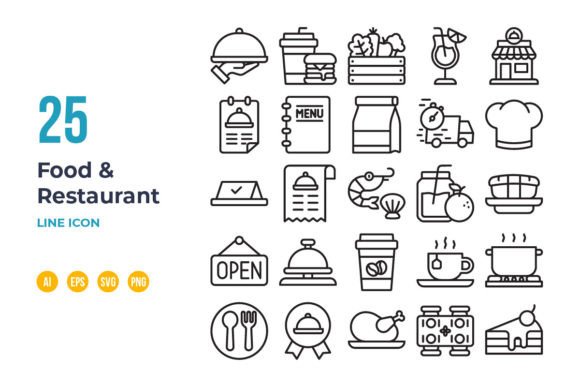
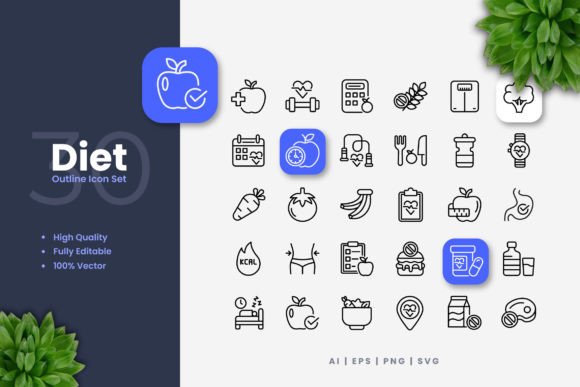
When the outline icon philosophy is applied to the theme of diet, the resulting library serves a wide array of communicative purposes. These icons become visual shorthand for a complex and important domain. A simple outline of an apple instantly suggests healthy eating, a fruit, or natural ingredients. An outline of a scale can symbolize weight management or balance. Icons depicting various food groups—grains, proteins, vegetables—can be used to create intuitive nutritional charts or educational materials.
The “outline” aspect is particularly beneficial here. In contexts where color might be misleading or unavailable—such in monochrome print, or when color is reserved for other data categories in an infographic—the clear black-and-white form ensures the icon remains legible and neutral. It allows the content itself, not the icon’s decoration, to carry the meaning.
Real-World Use Cases Across Industries
The utility of a comprehensive set of diet outline icons extends far beyond a single industry. Their application is observed in numerous professional and creative contexts.
For website and mobile app developers, these icons are integral to user interface design. They can be used for navigation menus in health apps, as feature symbols for meal logging functions, or as visual cues on recipe blogs to categorize dishes (e.g., vegan, gluten-free). The easy drag-and-drop nature of SVG or PNG files facilitates rapid prototyping and implementation.
Educators and researchers in nutrition science and public health find them invaluable for creating clear presentation slides, instructional pamphlets, and academic posters. The icons help illustrate concepts without relying on dense text, making information more accessible to diverse audiences.
In the realm of marketing and business, food producers, wellness coaches, and gyms utilize these icons in flyers, social media posts, and banners to advertise services, highlight product benefits, or create engaging infographics about their offerings. The PNG files with transparency allow for seamless integration into existing digital marketing layouts.
Content creators and hobbyists publishing books, e-books, or blogs on cooking and dieting use these assets to break up text, create visually appealing chapter headers, or design custom illustrations for their projects. The editable stroke means they can adjust the icons to perfectly match the typographic style of their publication.
Practical Considerations for Implementation
Adopting a set of diet outline icons into a project involves some practical considerations to maximize their effectiveness. First is the matter of consistency. A high-quality set typically includes a unified design language—similar stroke weights, proportional sizing, and a cohesive level of detail across all icons. This internal consistency ensures that when multiple icons are used together, they feel like part of a system, not a haphazard collection.
Another consideration is organization. A set that includes a readme file and well-named source files (AI, EPS, SVG) and rendered outputs (PNG) saves significant time. It allows the user to quickly locate the appropriate format for their specific task without needing to convert or regenerate files manually.
It is also important to recognize the distinction between the source files and preview mockups. The source files are the raw, editable vectors and the exported PNGs. These are the working materials. Preview mockups, which are sometimes shown in listings to demonstrate the icons in a realistic context, are not included as part of the usable assets. The user applies the icons to their own mockups and final designs.
Beyond Diet: The Versatility of a Theme
While themed as diet icons, the fundamental objects depicted often have secondary or symbolic meanings that broaden their use. An outline icon of a water bottle is clearly a diet icon representing hydration, but it could also serve as a general icon for “refreshment” or “travel” in a different context. A knife and fork outline is quintessential for diet apps, but it also functions as a universal icon for “food” or “restaurant” in any industry. This thematic flexibility means that a dedicated diet icon set can, with thoughtful application, serve projects that are only tangentially related to nutrition, simply because the icons are based on common, recognizable objects.
The Role in Creating Helpful and Trustworthy Content
From an SEO and content quality perspective, using clear, professional visual aids like diet outline icons enhances the E-E-A-T (Experience, Expertise, Authoritativeness, Trustworthiness) of a material. Well-designed graphics support expertise by demonstrating a thoughtful and competent presentation of information. They aid authoritativeness by making content more credible and polished. For the end-user, they significantly improve the helpfulness of the content by aiding comprehension and navigation.
When an article on complex dietary guidelines uses intuitive icons to illustrate food groups, or when a mobile app uses consistent outline icons to guide a user through a meal plan, the experience becomes more efficient and less frustrating. This practical understanding and real-world relevance is what separates useful content from mere information.
In summary, a collection of diet outline icons represents more than just a bundle of graphics. It is a scalable, customizable, and semantically rich toolkit built on the robust foundation of vector design. Its application spans digital and physical mediums, serving professionals, creators, and businesses who need to communicate concepts of food, health, and nutrition with clarity and visual coherence. By prioritizing recognizability and editorial flexibility, these icons become a lasting resource for projects that demand both aesthetic simplicity and functional depth.