Calendar Icons: The Essential Visual Language for Modern Communication
In a world saturated with information, clarity and efficiency are paramount. We communicate complex schedules, deadlines, and events across a dizzying array of platforms, from a corporate website to a social media flyer. This demands a visual shorthand—a symbol that is instantly recognizable, universally understood, and adaptable to any context. This is where Calendar Icons come into play, not as mere decorative elements, but as a fundamental component of contemporary design and communication.
The Rise of Minimalist Visual Communication
The trend towards simple and clean icon design is more than an aesthetic preference; it’s a response to changing habits and technological realities. Users, whether browsing a mobile app or reading an infographic, expect interfaces and materials that are intuitive and uncluttered. Busy professionals and casual readers alike process information quickly, and visually dense graphics can create friction. A clean Calendar Icon, with its straightforward geometric form representing days, weeks, and months, delivers meaning without cognitive load. This shift mirrors broader movements in UX design and branding, where simplicity equates to usability and trust.
From Static Symbols to Dynamic Design Assets
Historically, calendar imagery was often rigid—a specific graphic locked into a single size, color, and style within a publication or poster. Today’s workflows require flexibility. A marketer might need the same core icon for a website banner, a printed flyer, and an Instagram post, each with different technical requirements and visual tones. The evolution of Calendar Icons into fully vector-based, customizable sets directly addresses this need. They have transitioned from being static pictures to becoming dynamic, editable assets that integrate seamlessly into modern creative practices.
The Practical Power of Vector-Based Calendar Icons
The true value of a high-quality Calendar Icon set lies in its practicality for creators across disciplines. The ability to resize infinitely without quality loss, change color to match any brand palette, or edit stroke weight for emphasis is not a luxury; it’s a necessity for efficient project completion. When you can easily edit these icons in software like Adobe Illustrator or CorelDRAW, you unlock a level of control that streamlines the entire design process.
For instance, a freelancer designing a client’s event poster can tweak the icon’s color to perfectly complement the headline. An educator creating an instructional infographic can adjust the stroke thickness to ensure clarity when printed. A business owner updating their website can scale the icon to be perfectly legible on both desktop and mobile views. This adaptability saves time, maintains visual consistency across mediums, and empowers non-specialists to achieve professional results.
Meeting the Multi-Platform Mandate
Modern communication is inherently multi-platform. A single campaign or project regularly spans digital and physical realms. The included file formats—source AI, EPS 10, SVG, and PNG with transparency—are specifically curated to meet this mandate. The SVG file ensures perfect rendering on modern websites and apps, while the EPS and AI files provide full editability for print projects like books, banners, and posters. The PNG files offer the convenience of easy drag-and-drop for quicker tasks in social media or simple document creation. This comprehensive approach means that whether your final output is a high-resolution print or a lightweight mobile app screen, you have the right tool at hand.
Key Features That Translate to Real-World Benefits
Understanding the listed features in terms of real-world application makes their importance clear.
- High Quality Design: This ensures the icons are crafted with precise geometry and balance, making them visually appealing and authoritative in any context, from a corporate report to a community flyer.
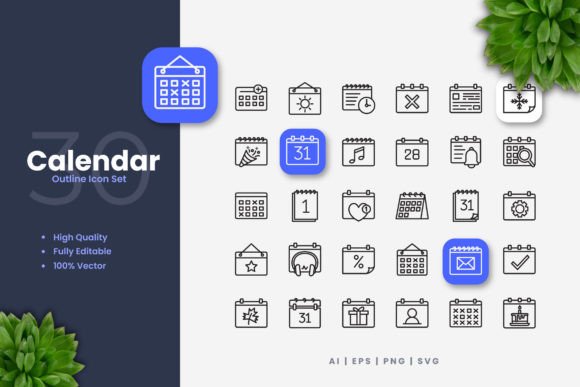
- 100 Vector & 100 Customizable: This offers not just variety—different calendar views, perhaps with or without numbering—but also the foundational freedom to adapt each one. You aren’t limited to the provided styles; you can make them your own.
- Editable Stroke: This allows for subtle branding. A thicker stroke might convey solidity and importance for a financial deadline graphic, while a thinner stroke could feel elegant and light for a cultural events calendar.
- Easy Drag and Drop: This caters to speed and simplicity. For a blogger quickly assembling a monthly schedule graphic or a hobbyist creating a club newsletter, this functionality removes technical barriers.
Integrating Calendar Icons into Your Creative Workflow
Incorporating these icons into your projects is straightforward. Start by selecting the icon style that best fits the tone of your content. For a formal business document, a clean, outlined calendar might be ideal. For a vibrant social media post announcing an event, a solid-colored icon could be more impactful. Then, using the provided source files, adjust its dimensions and colors directly in your vector software to align with your existing design system. Finally, export the icon in the required format for your target medium. This process turns a generic symbol into a bespoke visual element that reinforces your specific message.
The Enduring Relevance of Calendar Icons
While trends in graphic design evolve, the need to visually represent time and schedule is permanent. Calendar Icons, especially when delivered as a versatile, editable set, remain a critical asset in the toolkit of professionals, creators, and businesses. They bridge the gap between universal symbolism and unique brand expression. By choosing a set that prioritizes quality, customizability, and multi-format readiness, you invest in a resource that will serve countless projects, adapting to future needs and platforms as your communication demands grow and change. It’s a pragmatic choice for anyone looking to communicate dates, plans, and events with clarity, style, and consistency across the entire spectrum of modern media.