Sewing for Digital Communication: A Modern Set of Essential Icons
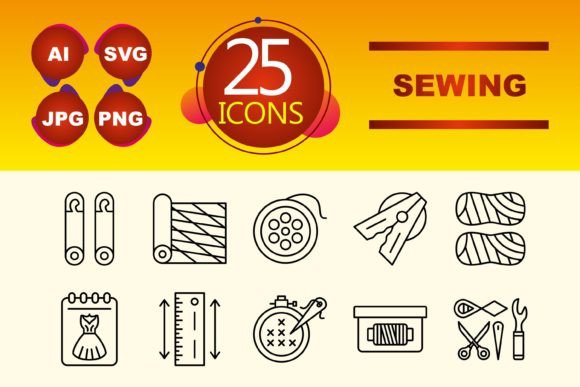
In the contemporary world of visual design, icons serve as the universal shorthand for ideas, actions, and categories. A specialized icon set, such as one focused on Sewing, transcends its literal craft to become a versatile tool for digital storytelling and interface clarity. This particular collection of Sewing icons represents more than just needles and thread; it encapsulates the concepts of creation, craftsmanship, assembly, and meticulous detail. For professionals across fields—from app developers illustrating a "make your own" feature to educators designing a presentation on historical textiles—these icons provide immediate, recognizable visual cues.
Integrating Sewing Icons into Your Design Process
The true value of any asset lies in its seamless integration into your existing workflow. Whether you are at the initial planning stage of a mobile app or refining the user interface for a website, incorporating thematic icons like these Sewing symbols requires a thoughtful approach. Begin by auditing your content needs. Identify moments where a visual can replace text, simplify navigation, or enhance aesthetic cohesion. A Sewing icon, for instance, could elegantly label a tutorial section, denote a "crafting" mode within a game, or serve as a decorative element in a blog post about DIY projects.
Consider the stage of your project. During the wireframing and prototyping phase, these icons can be placed to test user comprehension and flow. Their clear, line-based style ensures they remain legible even in early sketches. Later, during the high-fidelity design and implementation stage, the multiple file formats included—AI, SVG, PNG, and JPG—offer flexibility. The vector formats (AI and SVG) are essential for developers, allowing for scalability without loss of quality, crucial for responsive websites that adapt from desktop to mobile. The raster formats (PNG and JPG) are ready for immediate use in presentations, social media graphics, or printed infographics.
Practical Applications and Workflow Examples
Imagine you are a small business owner running an online store for fabric and patterns. Your website's navigation needs to be intuitive. Using a spool icon from the Sewing set for the "Thread & Yarn" category and a sewing machine icon for "Tools & Equipment" creates a faster, more visually engaging experience than text alone. This not only improves usability but also reinforces your brand's niche.
For a marketing professional creating a campaign email for a craft workshop, the inclusion of a simple needle and thread icon in the header can instantly set the theme, increasing open rates and click-throughs by providing immediate context. The line icon style, with its clean and uncluttered look, ensures the email remains professional and easy to read on all devices.
An educator or blogger might use these icons within an article or presentation slide to break up text and illustrate key points. A sequence showing a scissors icon, then a pattern piece icon, and finally a seam icon can visually guide the reader through the steps of a sewing project without requiring lengthy descriptions. This supports better learning outcomes and content retention.
Ensuring Quality and Consistency in Long-Term Use
A curated set of ten icons offers a balance between specificity and restraint. It provides enough variety to cover core Sewing concepts without overwhelming a project with unnecessary choices. This focused selection aids in maintaining design consistency. When you use icons from a coherent family, you guarantee a uniform stroke weight, stylistic treatment, and visual weight across all your materials. This consistency is a pillar of professional design, impacting brand perception and user trust.
Organization is key for efficient reuse. Upon acquiring the set, take time to categorize the files. Store the SVGs in a dedicated folder for web projects, the PNGs in a folder for quick digital use, and the AI files for future edits in Adobe Illustrator. This simple step saves considerable time during future projects, especially when working under deadlines. Furthermore, the line icon style is inherently compatible with a wide range of design themes. It can be easily colored to match your brand palette, outlined against different backgrounds, or even slightly modified without losing its essence, ensuring the assets remain useful for years.
Interaction with Other Tools and Resources
These Sewing icons do not exist in isolation. They are components meant to integrate with your broader design ecosystem. In a website template, they work alongside your chosen fonts, color scheme, and layout grids. In a mobile app, they must comply with platform-specific interface guidelines for size and touch targets. When used in presentation software like PowerPoint or Google Slides, their scalability ensures they remain sharp when projected on large screens.
The inclusion of an Adobe Illustrator (AI) file is particularly significant for professionals who require customization. You can open this file and adjust stroke widths, combine icon elements, or extract specific parts to create new, derivative visuals that still align with the set's style. This interoperability with major design software underscores the set's practical utility in a real-world, process-oriented workflow. It moves the asset from being a static image to being a adaptable design resource.
From Asset to Outcome: Enhancing Communication and Efficiency
The ultimate goal of incorporating any design element is to improve communication and efficiency. Sewing icons, when applied correctly, achieve this by reducing cognitive load for the end-user. A user scanning an interface recognizes a button with a recognizable sewing icon faster than they read a label. This speeds up their interaction and reduces frustration. For the creator, it streamlines the design process, providing ready-made, high-quality assets that eliminate the need to search for or create disparate visuals from scratch.
In business workflows, such as creating process infographics for a manufacturing team that includes assembly, these icons can symbolize quality control or hand-finishing stages. In personal projects, a hobbyist building a website to showcase their quilting portfolio can use the icons to create a cohesive and attractive navigation bar. The applications are bounded only by the need to visually reference the themes of making, repairing, tailoring, or crafting.
Adopting this Sewing icon set is a decision that pays dividends in preparation, execution, and final quality. By selecting a set with multiple file formats, you prepare for any output scenario. By choosing a line style, you ensure usability across contexts. By integrating the icons thoughtfully during your design execution, you create a more engaging and functional product. The result is a polished, professional outcome that effectively communicates your intended message, whether you are teaching, selling, building, or simply sharing your passion for the craft of Sewing in the digital space.